


A solar generator kit takes the guesswork out of off-grid power — it pairs a portable power station with one or more solar panels into a single, ready-to-use system. Plug in the panel, connect your devices, and you're drawing clean energy without fuel, noise, or complicated wiring. For anyone setting up their first portable solar system, knowing what each component does and how to match it to your actual power needs makes all the difference between a setup that works and one that falls short.
What Does a Solar Generator Kit Actually Include?
A complete kit has three core components: a portable power station, at least one solar panel, and the connecting cables. Together, they form a self-contained system capable of harvesting, storing, and delivering power wherever you need it.
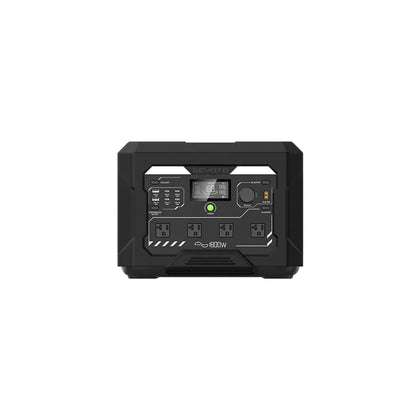
The Power Station — Battery, Inverter, and Ports in One Unit
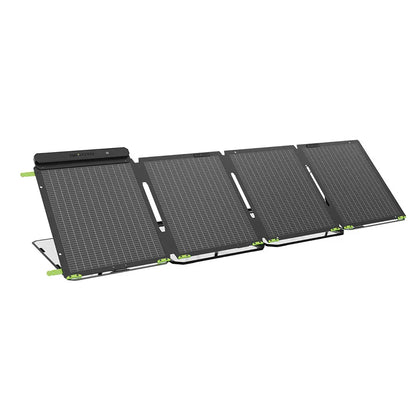
The Solar Panel — How It Converts Sunlight Into Stored Power
Why a Matched Kit Eliminates the Biggest First-Timer Mistake
Buying a power station and solar panel separately requires you to verify voltage compatibility, current limits, and connector types before anything works safely. Mismatched voltage can damage the station's charge controller or battery management system — and it's one of the most common issues first-time buyers run into.
A bundled kit solves this entirely. The panel and station are pre-matched by the manufacturer, so compatibility is guaranteed out of the box. The cables are included and correctly rated. You unfold the panel, connect it, and the station starts charging — no research required.
How Do a Power Station and Solar Panel Work Together?
The energy path is straightforward: the panel captures sunlight and generates DC electricity, which flows into the power station's built-in MPPT charge controller. The controller optimizes that input to charge the LFP battery as efficiently as possible. When you plug in a device, the inverter converts the stored DC power into the AC electricity your appliances run on.
Sunlight
→
Bifacial Panel
→
DC power
→
MPPT Charge Controller
→
LFP Battery
→
Inverter
→
AC/DC output to your devices
What Does "Solar Input" Mean — and Why Does It Matter?
Solar input refers to the maximum wattage the power station can accept from solar panels. It determines how fast the sun can recharge your battery — not how much the panel is rated for in isolation.
A 200W panel under strong sunlight in a location with around five peak sun hours per day can contribute roughly 800–1000Wh back into the battery over that window. But peak sun hours vary significantly by region. Arizona averages around six hours; the Pacific Northwest is closer to three or four. That gap directly affects how much your panel can recover in a single day, which matters a lot for multi-day off-grid use.
Stations that support higher solar input — up to 800W, for example — can accept two 200W panels simultaneously, cutting recharge time roughly in half compared to a single-panel setup.
Can You Charge the Station While Using It?
Yes, and it changes how you think about runtime entirely. Pass-through charging means the station can supply power to your devices and accept solar or AC input at the same time.
On a sunny day at a campsite, you might have a panel feeding in 150W while your devices draw 100W — the battery is actually gaining charge while you use it. Solar and AC input can also work together when you need the fastest possible recharge.
How Fast Can You Recharge When Solar Isn't Enough?
Solar input covers daytime recharging, but AC charging is your fastest fallback when the sun doesn't cooperate. The GEYOTO N1000 is built with this in mind — its advanced AC input technology brings the 1024Wh battery from empty to 80% in just 43 minutes via a standard wall outlet, and to a full charge in 68 minutes. That kind of recovery speed matters when you've had a stretch of overcast days and need the battery back at capacity before heading out again, or simply want a reliable top-up between uses without planning around it.
43 min
0 → 80% via AC fast charging
Full charge in 68 min
How Long Will a Solar Generator Kit Run Your Devices?
Runtime comes down to one thing: how much energy is stored versus how fast you're drawing it down. A 1024Wh battery with usable capacity factored in gives you a solid working reserve — here's what that looks like across realistic scenarios.
| Use Scenario | Devices Running | Estimated Runtime |
|---|---|---|
| Home backup basics | Mini fridge (150W) + Router + LED lights (50W) | ~4 hours |
| Camping comfort | Laptop (65W) + Fan (40W) + LED strip (15W) | ~6.8 hours |
| Medical / overnight use | CPAP machine (~30W) | 27+ hours |
| Light device charging | Phones + tablet (~20W combined) | 40+ hours |
These estimates account for typical inverter efficiency loss. High-wattage appliances like microwaves or electric kettles will drain the battery significantly faster — the practical strategy is to run them in short bursts and let the lower-draw devices handle the continuous load.
Solar recharging during daylight hours extends usable time well beyond these numbers. On a three-day camping trip with decent sun and a 200W panel, the battery can often recover enough between uses to sustain basic loads through each night.
How Do You Choose the Right Solar Generator Kit for Your Needs?
Start with what you need to power and for how long — the specs follow from there, not the other way around.
Step 1 — List Your Devices and Their Wattage
Most people overestimate what they'll need when they first look at specs. A practical starting point: identify the devices you genuinely can't do without during an outage or off-grid stay, and note their wattage. Common reference points — a mini fridge runs around 150W, a laptop 45–65W, a CPAP 20–30W, a Wi-Fi router 10–15W, and LED lights 10W or less. Split your list into "must stay on" and "occasional use" — only the first group needs to be covered by your continuous runtime estimate.

Step 2 — Match Battery Capacity to Your Daily Usage
For light use — phones, a laptop, and basic lighting — a smaller capacity station handles day trips and short camping stays comfortably. For home backup scenarios or multi-day outdoor use, 1024Wh is where most real-world needs land. It covers essential household loads for several hours and supports a wider range of devices without being too heavy to carry or transport in a vehicle.
Step 3 — Decide Between One Panel or Two
This is where a lot of buyers stall, but the logic is simple. One 200W panel is the right starting point for moderate daily use in reasonably sunny conditions — think clear-sky camping or occasional home backup where you can also top up with AC power when needed.
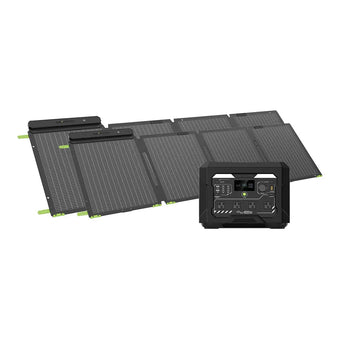
Two 200W panels make a meaningful difference when your situation involves any of the following: extended off-grid stays of three or more days, locations with lower average sunlight (the Midwest and Pacific Northwest in particular), or daily power needs close to the full battery capacity. A station that accepts up to 800W of solar input can run two 200W panels simultaneously, delivering roughly double the daily recharge compared to a single-panel setup. For anyone planning serious off-grid use, the second panel is often the difference between a system that keeps up and one that gradually falls behind.
 Click the image to shop now
Why LFP Battery Chemistry Makes a Difference for Long-Term Owners
Most quality portable solar generators today use Lithium Iron Phosphate (LFP) batteries rather than older lithium-ion chemistry. The practical difference: LFP cells are rated for 4,000+ charge cycles before dropping to 80% of original capacity, compared to 300–500 cycles for standard lithium-ion. They're also more thermally stable, produce no fumes, and are safe for indoor use — relevant if you plan to run the station as home backup during a storm.
For a first-time buyer, battery chemistry is worth paying attention to. A station that lasts through thousands of cycles doesn't just perform better over time — it also gives you more confidence using it regularly rather than saving it only for emergencies.
3 Common Setup Mistakes to Avoid With Your Solar Generator Kit
Placing the Panel at the Wrong Angle or in Partial Shade
Even a small shadow across one corner of a solar panel can reduce total output significantly. This is a characteristic of how panels are wired internally — a partially shaded cell creates a bottleneck for the entire string. For best results, face the panel toward true south (in the Northern Hemisphere), tilt it at roughly 30–45 degrees relative to the ground, and make sure nothing is casting a shadow across any part of the surface during peak hours.
Running High-Wattage Appliances Continuously
A 1024Wh battery running a 1500W electric kettle continuously would be empty in under 35 minutes. That's not a failure of the kit — it's just the math of high-draw appliances. The smarter approach: use high-wattage devices in short cycles (boil water, heat food, then switch off), and reserve continuous output for the lower-draw devices that actually need to stay on.
Expecting Full Panel Output on Overcast Days
On a heavily overcast day, solar panels typically produce between 10–25% of their rated output. That's enough to slow battery drain or add a modest charge, but it won't fully recover a depleted battery on its own. If you're in a region with frequent cloud cover, or facing a multi-day stretch of gray weather, having AC fast-charging as a backup plan — rather than relying entirely on solar — keeps you from getting caught short.
Getting the Right Kit for Your Setup
If you're looking for a solar generator kit that handles home backup, extended camping, or both without requiring any technical setup, the GEYOTO N1000 Solar Generator Kit is built around exactly those scenarios. It pairs a 1024Wh LFP power station — with 1800W continuous output and 18 output ports including PD 140W USB-C and Qi2.2 25W wireless charging — with a 200W bifacial panel rated at 26% conversion efficiency. AC fast charging brings it from flat to 80% in 43 minutes. Solar input supports up to 800W, so adding a second panel later is a straightforward upgrade.
For heavier daily use or locations with limited sunlight, the N1000 + 2× 200W panel configuration doubles the daily solar recharge rate — a practical choice for anyone planning more than a weekend away from the grid.
A well-matched kit handles most real-world use cases without overcomplication. The goal is reliable power when you need it, not the most impressive spec sheet.
Starter Setup · 1 Panel
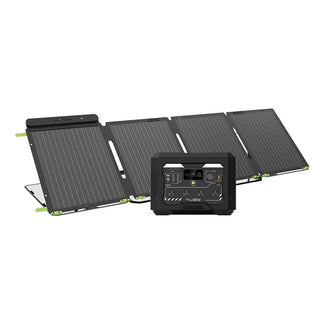
N1000 Kit — Starter Setup
1024Wh Power Station + 200W Bifacial Panel
1800W continuous output · 18 output ports · 43-min to 80% AC fast charge · 4,000+ LFP cycles · UL Certified · App control. Best for home backup, weekend camping, and locations with good sun.
Shop NowExtended Power · 2 Panels
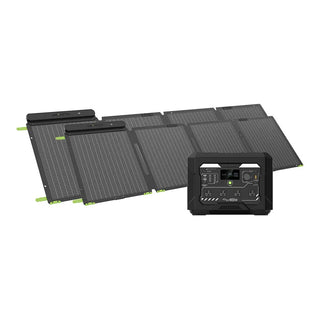
N1000 Kit — Extended Power
1024Wh Power Station + 200W × 2 Panels
Same 1800W station with 400W total solar input — roughly double the daily recharge rate. Best for multi-day off-grid stays, cloudy regions like the Pacific Northwest, or higher daily power consumption.
Shop NowFrequently Asked Questions
What is included in a solar generator kit?
A complete kit includes a portable power station, one or more solar panels, and the connecting cables. Everything is pre-matched for compatibility — no additional components are needed to start using it.
How long does it take to charge a solar generator with solar panels?
It depends on panel wattage and available sunlight. A 200W panel in conditions with around five peak sun hours can recover roughly 800–1000Wh per day. For faster top-ups, AC charging is the more predictable option — a 1024Wh station can reach 80% in 43 minutes via wall outlet.
Can I use a solar generator kit indoors?
Yes. LFP-based power stations produce no fumes, run silently, and include built-in battery management systems with multiple protection layers. They're well suited for indoor home backup use during outages.
Can I add more solar panels to my kit later?
It depends on the station's maximum solar input rating. A station that accepts up to 800W of solar input can support additional panels — two 200W panels run simultaneously would bring in 400W, well within that limit.
Is 1024Wh enough for home backup?
For essential loads — a mini fridge, router, lights, and device charging — a 1024Wh kit provides several hours of continuous backup, which covers most short to mid-length outages. For longer events or higher consumption, pairing the station with a second solar panel extends usable time considerably.