


An uninterruptible power supply for refrigerator use can help during short power interruptions, but it is not always the best answer for a longer refrigerator power outage. A traditional UPS is built for fast switching when grid power drops. A portable power station is usually better when you need several hours of refrigerator backup power, especially during storms, rolling blackouts, or emergency outages at home.
The right choice depends on three practical questions: How long is the outage likely to last? Can the backup device handle the refrigerator compressor startup? And does it provide clean AC power that is suitable for a motor-driven appliance?
For most U.S. households, the decision is simple: use a UPS for brief flickers, and choose a properly sized portable power station for longer refrigerator backup.
What Does a Refrigerator Need During a Power Outage?
A refrigerator needs clean AC output, enough continuous power, enough startup surge capacity, and enough stored energy to keep food cold through the outage window.
Unlike a phone charger or LED light, a refrigerator is not a steady, low-demand device. It uses a compressor that turns on and off throughout the day. When the compressor starts, the refrigerator may briefly demand much more power than it uses while running normally. That short spike is one reason some backup devices work well for small electronics but fail when connected to a refrigerator.
Before choosing any UPS for refrigerator backup, check the appliance label, owner’s manual, or a watt meter reading. Look for both normal operating demand and startup behavior. If you only size backup power around average wattage, the refrigerator may trip the backup system when the compressor starts.

Why Refrigerator Startup Surge Matters for Backup Power?
Startup surge matters because the compressor needs extra power for a short moment before the refrigerator settles into normal operation.
A backup device with enough battery capacity but weak surge support may still be a poor match. It might turn on, display full battery, and run small devices without trouble, yet shut down when the refrigerator compressor kicks in.
This is why refrigerator backup power should be sized with headroom. A backup power source should not be selected only because its capacity looks large. Continuous AC output and surge output are just as important.
Why Does Pure Sine Wave Output Matter?
Pure sine wave AC is the safer choice for refrigerator backup because it more closely matches household wall power.
Refrigerators include compressors, motors, relays, sensors, and control boards. These parts are more demanding than basic resistive loads. A modified sine wave output may cause noise, extra heat, poor efficiency, or startup issues in some appliances. For that reason, pure sine wave output should be treated as a baseline requirement when choosing a portable power station for refrigerator use.
Is a UPS for Refrigerator Backup Enough?
A UPS for refrigerator backup can be enough for short interruptions, but many traditional UPS units are not designed for multi-hour refrigerator operation.
A UPS is built to switch quickly from grid power to battery power. That fast transfer is useful when your home experiences power flickers, short blackouts, or voltage dips. It helps prevent sudden shutdowns and can bridge the gap until power returns.
The limitation is runtime. Many small UPS units are designed for computers, Wi-Fi routers, monitors, and office electronics. Those loads are different from a refrigerator compressor. A refrigerator may need higher startup power and longer backup time than a compact UPS can provide.
A UPS may be a good fit if:
- Your power interruptions usually last seconds or minutes.
- You want automatic switching during brief outages.
- Your refrigerator has modest startup requirements.
- The UPS provides pure sine wave AC and enough surge support.
- You do not expect the UPS to run the refrigerator for several hours.
A UPS is less suitable when the outage may last through a storm, overnight, or across several hours of utility repair. In those cases, the issue is not only transfer speed. The issue is stored energy.
Is a Portable Power Station for Refrigerator Backup Better?
A portable power station for refrigerator backup is usually better when the outage may last longer than a short flicker.
A portable power station stores more usable energy than many small UPS units and can be moved where it is needed. For a household, that flexibility matters. The same device may support a kitchen refrigerator during a power outage, a garage freezer during summer heat, lights during an emergency, or phone and router charging when the grid is down.
Portable power stations are also practical for renters and apartment residents who cannot use a fuel generator. They do not produce exhaust, do not require gasoline storage, and can be used indoors when operated according to the manufacturer’s instructions. That makes them a realistic option for U.S. homes, apartments, RVs, cabins, and emergency preparedness kits.
A portable power station may be the better fit if:
- You want several hours of refrigerator backup power.
- You live in an area affected by storms, heat waves, or grid instability.
- You need backup power for a refrigerator plus phones, lights, or a router.
- You want portable power for both home backup and outdoor use.
- You prefer a battery-based solution instead of a fuel-powered generator.
The main tradeoff is transfer behavior. Some portable power stations offer backup or pass-through features, while others require manual connection when the outage begins. If automatic switching is essential, check the product’s backup mode carefully before buying.
UPS vs Portable Power Station for Refrigerator: Which One Should You Buy?
Choose a UPS for short automatic protection. Choose a portable power station for longer refrigerator backup power and broader emergency use.
| Decision Factor | Traditional UPS | Portable Power Station |
|---|---|---|
| Best for | Short interruptions and fast switching | Longer refrigerator backup power |
| Main strength | Automatic transfer during brief outages | Higher usable battery capacity and portability |
| Runtime | Usually limited under refrigerator load | Usually longer, depending on capacity and refrigerator draw |
| Startup surge | Must be checked carefully | Higher-output models often provide more headroom |
| Output quality | Pure sine wave should be confirmed | Pure sine wave should be confirmed |
| Placement | Usually fixed near one appliance | Can move between kitchen, garage, RV, or emergency area |
| Recharging | Usually wall outlet based | May support wall, solar, car, or other charging methods |
| Best user | Someone with frequent short flickers | Someone preparing for multi-hour outages |
For most households worried about food spoilage during a refrigerator power outage, outage duration is the deciding factor. If your power cuts out for a few seconds, a UPS may solve the problem. If the outage may last long enough to affect food safety, a portable power station is usually the more practical choice.
How Long Can Backup Power Run a Refrigerator?
Backup runtime depends on battery capacity, refrigerator power draw, compressor cycling, room temperature, food load, and how often the door is opened.
A refrigerator does not draw the same amount of power every minute. The compressor cycles on and off. A full refrigerator may hold temperature better than an empty one. A refrigerator in a hot garage may demand more power than the same model in an air-conditioned kitchen. Door opening also changes the result quickly.
Still, planning estimates are useful when comparing backup power options.
| Refrigerator Scenario | Example Average Load | Estimated Runtime With 1024Wh Capacity |
|---|---|---|
| Full-size refrigerator during normal cycling | 150W | About 5.5 hours |
| Energy-efficient household refrigerator | 100W | About 8 hours |
| Compact refrigerator or mini fridge | 60W | About 13.5 hours |
These estimates are not guarantees. They are planning numbers for comparing backup options. Real runtime may be shorter or longer depending on the refrigerator, ambient temperature, startup behavior, battery condition, and other connected devices.
If you plan to power more than the refrigerator, add those devices into your total load. A router, light, phone charger, or small fan may not use much power individually, but they still reduce available runtime.
How Long Can Food Stay Safe During a Refrigerator Power Outage?
A closed refrigerator can usually keep food cold for about four hours during a power outage, so backup power becomes more valuable when an outage may last longer.
The first step during a power outage is simple: keep the refrigerator and freezer doors closed as much as possible. Opening the door releases cold air and makes the appliance work harder once backup power is connected.
For short outages, keeping the door closed may be enough. For longer outages, refrigerator backup power gives you more control. It can help maintain cold storage while you wait for grid power to return or decide whether to move perishable food to a cooler with ice.
A practical outage routine looks like this:
- Keep the refrigerator and freezer doors closed.
- Check whether the outage is limited to your home or affecting the area.
- Confirm the refrigerator’s wattage and the backup device’s output rating.
- Connect the refrigerator only to a properly rated backup power source.
- Avoid connecting multiple high-wattage appliances at the same time.
- Use a refrigerator thermometer when available to monitor food safety.
Backup power should not replace safe food handling. If perishable food has been too warm for too long, discard it rather than taking a risk.
What Specs Matter Most When Buying Refrigerator Backup Power?
The most important specs are battery capacity, continuous AC output, surge output, pure sine wave power, charging speed, battery chemistry, and built-in protection.
Capacity: How Much Energy Can It Store?
Capacity tells you how long the backup system may support the refrigerator.
For refrigerator backup power, capacity is usually measured in watt-hours. A higher watt-hour rating generally means longer runtime, but capacity alone is not enough. A large battery with weak AC output may still fail to start a refrigerator compressor.
AC Output: Can It Run the Appliance?
Continuous AC output tells you how much power the device can provide steadily.
This rating should be higher than the refrigerator’s normal operating demand, with room for other essentials if you plan to connect them. If you want to run a refrigerator, router, phone chargers, and lights together, check the combined load.
Surge Output: Can It Start the Compressor?
Surge output matters because refrigerators need extra power at startup.
A backup device may run a small lamp or charge phones easily, yet shut down when connected to a compressor appliance. When comparing products, look for surge headroom rather than choosing a device that barely meets the refrigerator’s expected load.
Pure Sine Wave: Is the Output Suitable for a Refrigerator?
Pure sine wave AC should be a priority for compressor-driven appliances.
This helps provide stable power for motors and electronic controls. For a refrigerator, pure sine wave output is not a luxury feature; it is part of responsible sizing.
Charging Speed and Recharge Options: Can It Recover Quickly?
Recharge speed matters when outages come in waves.
If the power returns briefly, a fast-charging portable power station can recover useful capacity before the next outage. Solar and car charging can also help in longer emergencies, though solar performance depends on sunlight, panel size, and charging conditions.
Battery Chemistry and Safety: Is It Practical for Indoor Backup?
For indoor home backup, battery design matters.
LiFePO4 batteries are widely used in modern portable power stations because they are known for stability and long service life. Built-in battery management systems can help protect against overcharge, overheating, short circuits, and other abnormal conditions. Users should still follow the manufacturer’s instructions, keep ventilation clear, and avoid overloading the unit.
Where Does GEYOTO Fit Into Refrigerator Backup Power?
GEYOTO fits households that want a portable power station for refrigerator backup, emergency storage, and everyday essential power.
After comparing UPS units and portable power stations, the key buying criteria become clear: capacity, output, surge support, pure sine wave AC, safety design, and recharge speed. GEYOTO N1000 is a natural example of a backup power option built around those needs.
GEYOTO N1000 offers 1024Wh capacity, 1800W AC output, pure sine wave power, LiFePO4 battery chemistry, and up to 3000W surge load support. For refrigerator backup, those specifications matter because the device must not only store energy but also handle compressor startup and stable AC operation.
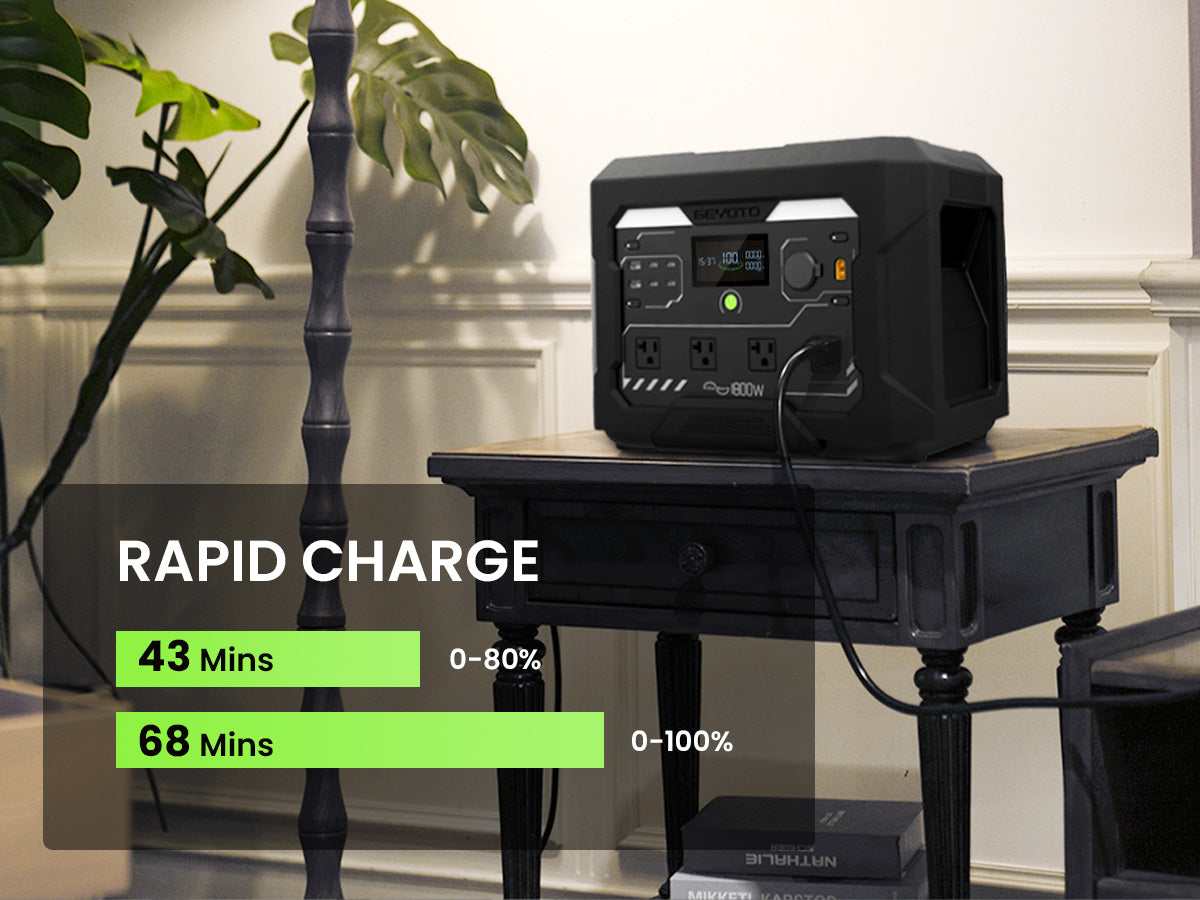
Its fast charging capability is also useful for outage preparation. Recharging to 80% in around 43 minutes means the unit can recover usable capacity quickly when grid power returns between outages. For households in storm-prone areas, that can be more practical than relying on a small UPS that may drain quickly under refrigerator load.
GEYOTO N1000 is not only for refrigerators. In a real home outage, most people also want to charge phones, keep a Wi-Fi router running, power a light, or support small emergency devices. A portable power station gives more flexibility than a single-purpose backup device, as long as the total connected load stays within its rated output.
When Is GEYOTO N1000 a Better Fit Than a Small UPS?
GEYOTO N1000 is a better fit when you need refrigerator backup power for more than a short flicker and want one device that can support other essentials.
A small UPS may help if the power blinks off and comes back in a few minutes. But if a summer storm knocks out power across the neighborhood, the main concern becomes runtime. That is where a portable power station becomes more useful.
For example, a homeowner could connect a kitchen refrigerator during the first part of an outage, then rotate power to phones, a router, or lights as needed. A renter could keep essential devices running without using a fuel generator indoors. An RV owner could use the same unit for travel and home emergency backup.
The best setup is not the biggest device on paper. It is the device that matches the refrigerator’s startup needs, expected outage duration, and the household’s real emergency routine.
Looking for Refrigerator Backup Power That Also Works Around the Home?
Choose a backup power option that fits the refrigerator first, then check whether it can support your other essential devices.
For households comparing a UPS for refrigerator use with a portable power station for refrigerator backup, GEYOTO N1000 Portable Power Station offers the kind of capacity, pure sine wave AC output, and surge support that matches common home outage needs. It is especially practical for users who want one backup power source for the refrigerator, phones, Wi-Fi, lights, emergency storage, RV use, or garage backup rather than a device that only handles short power flickers.
Before connecting any appliance, confirm the refrigerator’s power requirements and keep the total load within the power station’s rated limits.

Click the image to shop now
What Is the Best Backup Choice for a Refrigerator Power Outage?
For short flickers, use a properly rated UPS. For longer outages, choose a properly sized portable power station.
A traditional UPS is useful when your power interruptions are brief and you need fast automatic transfer. A portable power station is usually the better choice when you are preparing for several hours of refrigerator backup power during storms, outages, or emergency conditions.
The best uninterruptible power supply for refrigerator backup is not always a computer-style UPS. For many homes, the stronger solution is a portable power station with enough capacity, pure sine wave AC, surge headroom, and safe indoor battery design.
FAQ
1. Can I Use a UPS for a Refrigerator?
Yes, if the UPS has enough continuous output, enough surge capacity, and pure sine wave AC. Many small UPS units are designed for computers and network equipment, so check the specifications carefully before connecting a refrigerator.
2. Is a Portable Power Station Better Than a UPS for a Refrigerator?
A portable power station is often better for longer outages because it usually offers more usable battery capacity and more flexible charging options. A UPS is better for fast switching during short interruptions.
3. How Long Will a Portable Power Station Run a Refrigerator?
It depends on battery capacity, refrigerator power draw, compressor cycling, room temperature, and how often the door is opened. A 1024Wh unit may support many refrigerators for several hours, but runtime should always be treated as an estimate.
4. What Size Portable Power Station Do I Need for a Refrigerator?
Choose a power station with enough battery capacity for your expected outage time, enough continuous AC output for normal operation, and enough surge output for compressor startup. Pure sine wave AC is strongly recommended for compressor appliances.
5. Can I Plug a Refrigerator Directly Into a Portable Power Station?
Yes, if the portable power station is rated for the refrigerator’s load and provides suitable AC output. Avoid overloaded extension cords, do not exceed the rated output, and follow the manufacturer’s safety instructions.
6. Should I Keep the Refrigerator Door Closed During an Outage?
Yes. Keeping the door closed helps maintain cold temperature longer and reduces the amount of backup power needed once the refrigerator is connected to a backup power source.